
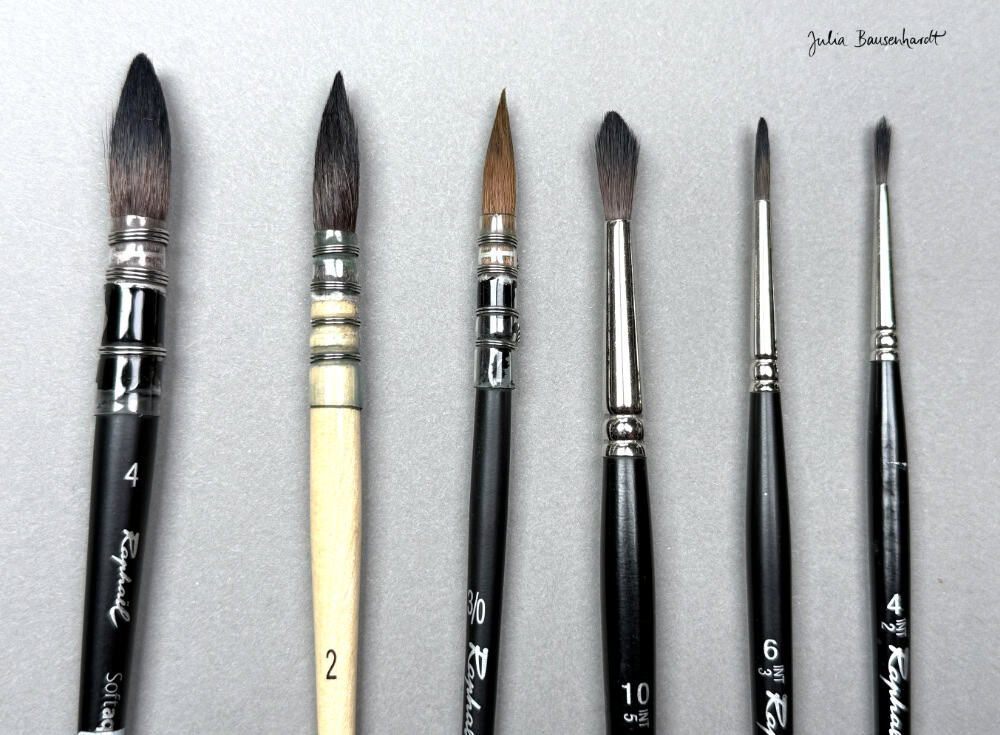
Some of you have asked me what kind of brushes I prefer, so here’s an overview of the brushes I use most for my everyday sketching and especially landscape painting.
- I’m not really brand-conscious when I choose brushes, for a long time I’ve simply used the inexpensive synthetic rounds that my local art store offered (the “I love art” line from Gerstaecker in Germany). You have to replace synthetics anyway when they lose their ability to form a pointy tip, so I chose brushes in a lower price range.
- Right now I mainly use brushes from the French company Raphael these days (sadly they don’t reimburse me in brushes to say this), they have a line called Softaqua that’s synthetic and is said to mimic squirrel hair. They have a rather round tip, which I like for certain elements like foliage. They can be used for a bit longer, but eventually they all get bent tips (you can still use them for gouache in most cases).
- I’ve discovered mop brushes, also called quill brushes or French watercolor brushes, a while ago, and while I do not really enjoy the way the wire binding or ferrule tends to carve into my fingers, they can hold a lot of water and have a fine tip at the same time. They’re great for landscape sketching, for laying down those big light washes at the start, but also for detailed brushwork.
- I started with the Raphael Softaqua line of mop brushes which is lovely but sometimes a bit too rounded at the tip for fine details. But they’re great for the first 70% of a landscape sketch.
- There’s a similarly inexpensive line of mop brushes from Gerstaecker (made by the company Jax, 50% synthetic and 50% squirrel), and Raphael also offers an “Imitation Kolinsky” line that is entirely synthetic and works very well, I believe it’s the mop variant of their 8344 line. Again, I’m using rather inexpensive brushes here, the bristles don’t hold shape forever. I try to take good care of all my animal hair brushes so that I don’t have to buy new ones so often.
- For details I either use smaller sizes (Raphael Softaqua line), or reach for smaller mop brushes that can have an incredibly sharp tip, or I use a fine round brush from my eclectic collection of brushes (they tend to accumulate). This can backfire though, if a brush doesn’t react the way you thought it would.
Since I do not create huge paintings in my sketchbook, I mainly use smaller sizes, often mop brushes around 0-3, and classic round brushes up to size 8-10. For details I use sizes 1-4. Brush companies don’t have a standardized numbering system, so I can’t give you any absolute measurements.

I don’t believe into investing lots of € into my brushes, since they wear down anyway, and when I was sketching outside a lot I didn’t want to lose a 80€ sable brush.
For my everyday sketching, I don’t use more than two or three different brushes, a bigger and a smaller mop brush, and then something small for details.
Other brushes I use less regularly:
- a big flat goat hair brush for wetting paper
- I still have some of my old “I love art” round brushes, great for painting in big shapes
- a flat Leonard brush I mainly use for swatching
- a small liner brush that useful for painting really small stuff like small grasses, electrical wires

…and of course I have a ton of other brushes that sit around and do nothing except for one day a year. But that’s fine, they don’t take up much space.
My main tips for brushes would be: treat them well (don’t bend the tip, let them dry horizontally if possible), and explore what kind of marks they can make. This can be a stress-free activity plus you’ll learn something about painting. Get in those brush miles!
What kind of brushes do you like and use the most?



Thank you so much for this post, most interesting and useful. Have you abandoned the swordliner and flat brushes you used to use for gouache landscape paintings?
It’s so lovely to have regular posts from you again!
Thank you Gill! Yes that’s right I don’t really use sword and flat brushes a lot right now. I find I prefer the rounded shapes I can create with my current brushes. I think I haven’t painted with gouache in over two years – so maybe I’ll bring those brushes back when I return to it at some point. :)
Thank you!
Thanks! How do you gauge when brushes need replacement?
Good question! It’s most noticeable when you can’t paint fine lines anymore even though you could before. This is either when the hairs can’t form a pointy tip anymore or when the tip is bent and malformed somehow – it happens more often with synthetics. Very old brushes sometimes lose hairs or the hairs simply break off. Some of these brushes can get a good second life when you use them for applying masking fluid, for spattering, or for painting with gouache/acrylic paint.
Thanks! A big problem I have is how to protect them when traveling. I tried travel brushes. They were more expensive, though, and wear out just as quickly. It would be less expensive to use regular brushes if I could avoid damaging them in transit.
Haha yes I hate travel brushes because I always lose the second part you need to attach at the end, or it falls off while painting. Very inconvenient. For protecting the bristles I either use those little plastic caps that the brushes often are sold with (they are finicky but protect the brush well) or pieces of old plastic straws. I’ve also seen artists put their brushes into hard cases fitted with a bit of foam material that holds the brushes in place.
Hi I just bought a Holbein adjustable brush holder, plastic, looks like a long travel toothbrush holder. I once used an actual toothbrush holder until I found this. It was around $5 on Amazon. Dick Blick sells it for a dollar cheaper. I’m very protective of my brush bristles!
That sounds interesting. Does it protect the brushes from moving around inside the case, so that the bristles won’t get pushed against the top cover? A toothbrush holder is a great solution too, I’ll try that out!
Another great blog post and perfect timing as I’m beginning to try different watercolor brushes and as the temperature warms up, I desire to paint more landscapes as well. Keep it up Julia!
Oh I hope you’ll have many wonderful sketching sessions in the sun, Jenny!
I look forward to your blog posts and brushes are especially fascinating. I use Princeton Neptune ( a soft, rounded shape) , Princeton Aqua Elite pointed rounds, and a mop brush, too. Thanks!
Thank you so much Judy! I’ve heard a lot about the Princeton brushes, I want to try them at some point. It seems there are always new art supplies one can test. :-)
I like the Princeton Aqua Elite line of brushes. They’re very reasonably priced, and seem to hold up well, although I don’t paint very often.
Thanks for sharing! I’ve wanted to try those for a while.
I hate when the brush bristles come out in the middle of something you are painting too! It’s nice to see you posting again more Julia, so I hope you are feeling better as Spring approaches and you will be painting outside again soon. :)
I really hope so too, I’ll just have to take one day at a time and listen to my body. :) And yeah, those brush bristles embedded in my most beautiful wash are so annoying!
I use Chinese brushes, which is my quirk. However the straw or bamboo “place mats” are great for saving your brushes in travel. I lie them flat on the straw place mat, roll them up and wrap the roll with a couple rubber bands. Maybe not perfect, but I’m still happy with those brushes after countless times I put the roll in my day pack for sketching.
You can usually find the brush “place mats”If there are any Chinese book stores or knick-knack stores in your neighborhood. Sometimes you have to ask at the counter, but they’re not expensive. Without straw or bamboo mats, a hard plastic box also works. I just have to remember that plastic doesn’t allow the brushes to dry, so I’ll need to remove them as soon as I’m home.
That’s a good reminder Janet, I have one of these brush place mats too. They are great, though almost a bit too big when I’m only taking my brushes for a short walk. But for longer travels they work really well. I have some Chinese brushes too, I really like how soft they are and how much water and pigment they can hold. The backgrounds of all of the great Studio Ghibli animation films are painted with these kind of brushes, so you’re in good company.
Do you think it’s okay to let brushes dry vertically but upside down? I have a rack with a wire coil that you can wedge the handles into. The tip hangs down free and not touching anything, with a tray underneath to catch drips. Is it still better to dry horizontally anyway?
Yes absolutely, that sounds like a great helper tool. I just dry them in a horizontal position so that water doesn’t seep into the ferrule.
Thank you for this post. Yes, it’s a pet peeve of mine that every synthetic brush I’ve used in the past always becomes less ideal due to its eventual bent tip, some sooner than others. That’s why I have some natural hair brushes, but I am an animal lover so I won’t be buying them in the future anymore. I have recently discovered you and your blog and I have been enjoying reading your older posts with my morning coffee and it has become my favorite ritual each day! Praying for your well being and good health Julia. I think you are a very engaging and wonderful writer! Sunny
Thank you so much and welcome again to this small sketching community! Yeah it’s not always easy with these decisions – natural hair brushes are bad for the animals involved, and synthetic brushes are essentially plastic waste when they’re older. I just try to keep everything in good shape as long as possible. Glad to hear you’re finding value in the blog archive – that’s what it’s for! :-)
Thank you again, Julia, for sharing about brushes. There are all ranges of prices and it’s good to know it’s okay to buy cheaper ones, ones that fit a tight budget. It’s good to know that yes, they will get the job done.
Happy Springtime and best wishes for good health!
Yes, absolutely, and it’s more or less the same with paints and paper. Thank you so much for your kind wishes Audrey!