

Over the summer, I’ve been simplifying my sketching approach and mainly worked with ink and added only loose washes. I’ve had less patience for very elaborate watercolor sketches, particularly when sketching outside. There’s something very freeing about letting go of a very tight, layered painting style, maybe because it lets you explore another beautiful side of the watercolor medium – the loose, free-flowing aspect of it.
I still love precision and tiny details, but instead of rendering them with a brush I mainly use drawing tools like pencils and fountain pen for that. The drawing does the heavy lifting right at the start, so that I don’t have to fiddle endlessly with fine brushes to include a satisfactory (to me) amount of interesting small focal areas. Instead I use my line art to do this.
Somehow it’s taken me years to realize that while I like some paintings and the act of painting, I’m visually deeply attached to drawing, inking, printing and engraving techniques, and all kinds of line art, and always have been. Even the old master paintings I gravitate towards always have that graphic quality and attention to detail, instead of being about loose brush work and lost edges.
Sometimes I can be very slow in realizing what I like.
The good news, though, is that it’s fun to incorporate this more into my art, which results in me liking my own art more. And sketching like this isn’t slow at all, which always held me back from painting more. I find it incredibly freeing to focus on a robust, more or less precise drawing as the first step, and then (optionally) add a quick wash here and there.
I’ll show you an example of how I approach this.

For this sketch of a linden twig, I quickly sketched the leaves in pencil, using the actual twig as a measuring help – I put it directly onto the page and marked a few points. I forgot to take a picture of this.
For organic subjects like plants it’s not crucial to always have absolutely exact measurements – if you’re not doing a scientific drawing. With the fountain pen I added clear lines on top and redefined some areas like the serrated leaf edges. In a second step, I added textural details like those little dark spots and veins. For this technique to work you need to have waterproof ink in your fountain pen so that you can add paint over your inked outlines later without the ink dissolving – I’ve used a Kaweco Sport with De Atramentis Document Black ink here. I like fountain pens, but you can achieve a similar result with a waterproof fineliner.

I then mixed two variants of green – one slightly cooler with Cobalt blue, and one lighter and warmer, with yellow added in. I often start with WN Sap Green for these green mixes to save time, but you can also mix greens from scratch with blue and yellow – this can lead to more interesting, varied greens.

I loosely applied a very juicy wash of paint and dropped in cooler or warmer paint mix as I observed the different areas on the leaf. The trick to keep it loose here is to use a big brush that comes to a sharp point (handy for those serrated edges), but that will make it impossible to noodle around. Lots of water also helps. You can always soak it up again with a dry brush if the puddle is too big. I’m using a farily small mop brush here.

I also decided I would only add color to some leaves – this gives the sketch an interesting unfinished look. It’s a study, and the inked parts are interesting enough to carry parts of it.

As a last step I added very few details in yellow ochre with a smaller brush, and a few green layers to reinforce the color of the leaf, always conscious of not overworking the sketch, and keeping it loose enough. This way of including most details in the drawing stage means that I get away with one or two paint layers, and it doesn’t matter if I apply the paint in a slightly sloppy way – the drawing underneath defines the shapes and amount of detail.

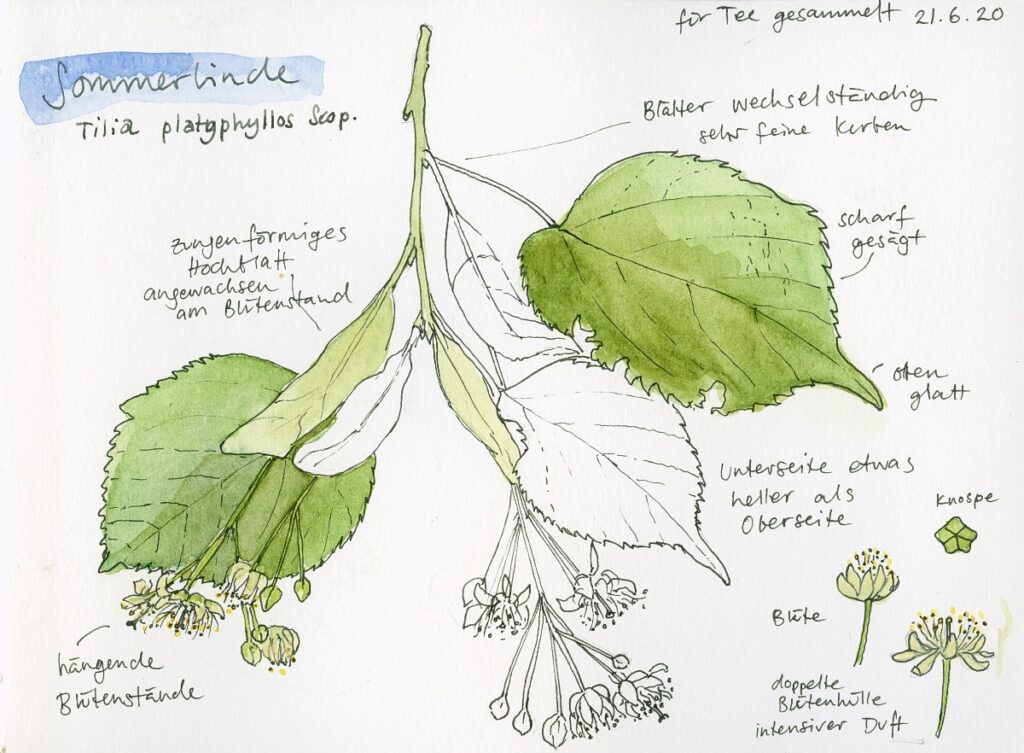
Linden leaves are wonderful subjects and I enjoy to sketch them a lot – as a comparison here is one I did in 2020 in a similar style.
These leaves are lovely – and I enjoy using pen and watercolour wash .
I really enjoyed this art and all the steps you shared. I tried this style once but only once , really enjoyed it but for some reason I did not continue with it. You have awaken a sleeping art style and now I am ready to jump back in, And what a great time to start, the fall season when nature gives us so much to work with. I use watercolor pencils mostly but perhaps it’s time I revisit those tubes of watercolor paint, just sitting on the table. Thanks you so much for sharing and relighting a spark in my sketching/drawing nature journey.
Wonderful! I enjoy the look of some leaves left unpainted. It’s a good reminder for me to try – I tend to want to add color to everything! Thanks for the inspiration!
Julia,
Your drawing/painting is exquisite. There is nothing extraneous yet the leaves seem to glow from within. It is also inspiring to hear your thoughts on being called to a technique that is authentic and true for you. So beautiful. Thank you for sharing this!
Laura
These leaves are really beautiful! Thank you for sharing. May I ask what type of sketchbook are you using? Is it 100% cotton? Thank you in advance. Adamalia.
Thaks to you Julia for your inspiration. I have learn a lot from your videos and e-mail letters. I found my old fountainpen for sketching now. Had only watersoluble ink, and therefore no adding of watercolor. Next step for me is buing a new fountainpen and use watersoluble ink. What pen do you recomand?- Often I sketch in the field.
Love the juxtaposition of that freshly painted wet Tilia leaf,beside a dried watercolour leaf, over the line ink sketch in your sixth frame: wonderful immediacy to your study process. Good stuff!
thankyou
Love it!
Thankyou Julia. This is the technique I love and I will enjoy it . I haven’t been able to get drawing and have been wanting to do outdoor sketches with looser washes.
I must say that I also have been drawn to line drawings since primary school. I absolutely loved the black and white illustrations in the school magazine. I actually found some of these old magazines on ebay from the late nineteen sixties and snapped them up.