

I’ve tried out a few new fountain pen inks recently, and I think I have a few good candidates for replacing the Rohrer & Klingner Sketch Ink I’ve been using in the past.
As some of you know, I’ve been using waterproof Rohrer & Klingner Sketch Ink for a while in my fountain pens. They’re affordable waterproof inks that are safe to use in fountain pens.
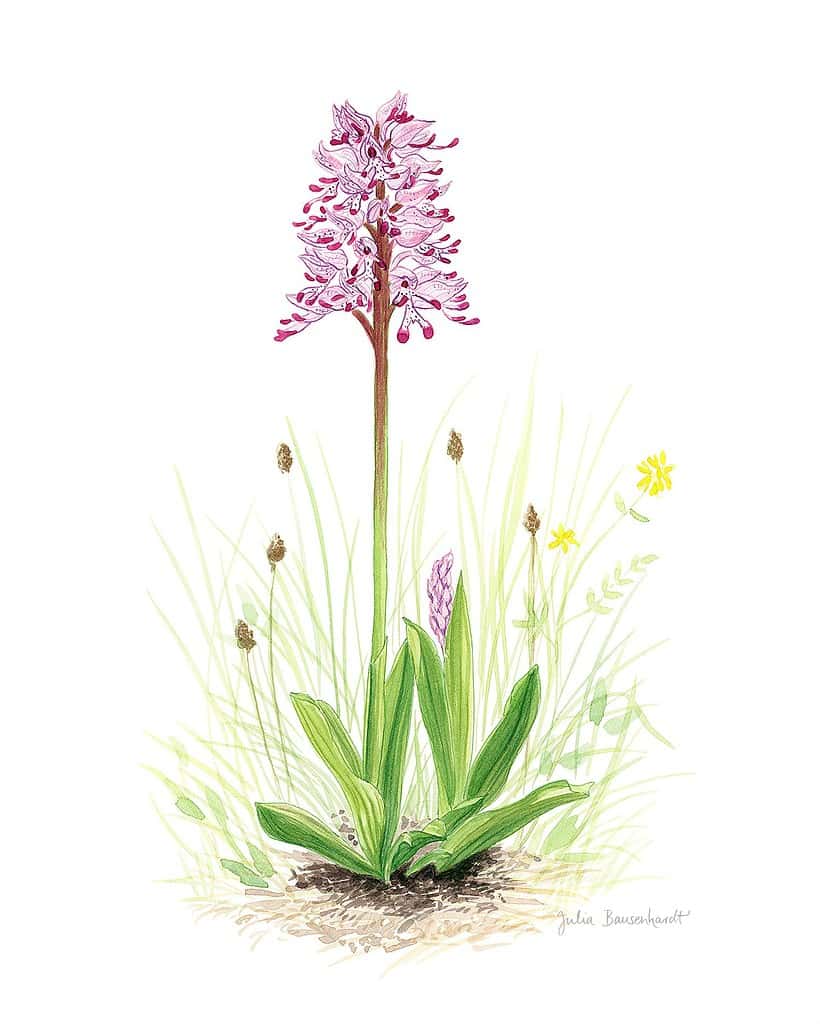
I’ve never been 100% happy with them, since they tended to be a bit dry (scratchy) in my fountain pens and could sometimes be hard to reactivate, but at the price point I didn’t much think about it. I’ve sketched a lot with them over the years, and also finished a few illustration projects with these inks. The outlines of these botanical illustrations were done with Sketch Inks:

Then I started doing lightfastness tests for all of my watercolor paints, and I included a few swatches of the inks and found (after a year of exposure to daylight) that the SketchInks are far from lightfast and some of them faded quite a bit, especially when diluted.
You can see the exposed inks on the right side, almost all colors except the magenta and bright green faded:


This is not an issue for most sketchers since what’s in the sketchbook isn’t exposed to sunlight that much. But I also create original art that people (including myself, lol) put on their walls, and I don’t want to take risks and have my artwork fade. So I started looking for alternatives.
I’ve been trying out two different brands on waterproof fountain pen inks:
- De Atramentis document ink
- Octopus Write & Draw ink
Both of these come in a lot of colors, and are considerably more expensive than the SketchInk, but they claim to be “document proof” – so hopefully at least somewhat more lightfast.
I’ve been using De Atramentis document ink for a few months now and have been very happy with it so far. It doesn’t dry in my fountain pens (mostly Kaweco Sport pens these days) as fast and it has a great flow and there is a nice selection of colors available.
The Octopus W&D I tried feels just slightly more dry in a fountain pen, but it’s still a lovely ink to sketch with. I’ve selected a few blacks and browns to test, as well as a few of the colors I need from time to time for botanical work.

Both lines of ink come in a full color range, which I like and prefer to the somewhat limited selection of the R&K SketchInks. I don’t really need over 20 or 30 different colors of ink, but having primaries available is great. I found I typically use black, brown and blue the most (for drawing and notes), and sometimes green, pink, yellow or purple for botanical sketches, but not in large amounts.

Both inks can be mixed (within their own line) to create new colors. That’s great if you don’t want to buy so many big ink containers, but still have somewhat flexible color choices – I mixed a lovely muted dark blue that way. I’ve found however that sometimes mixed inks will form weird pigment clusters, that might be an issue inside a fountain pen feed. So it’s probably safer to rely on pre-mixed colors.
De Atramentis also has a thinner that you can use to dilute your ink, hopefully without compromising on lightfastness. I haven’t tested it yet.
This was a breaking point for some of the R&K SketchInks, they held up well in masstone (full strength) but a few colors faded considerably when you diluted them with water, particularly reds, greens and browns. A thin dispersion of pigments will more likely lead to fading (this is also true for some watercolor pigments), and maybe mixing the inks created another chemical instability.
I’m currently sketching with (undiluted) ink from sample vials for now, fortunately there are online shops that offer these! So while I can’t say anything about the ink containers, the quality and the feel of both ink types so far has been very good.

One thing I don’t enjoy about buying ink is that you usually have to buy huge containers (30ml or even 50ml) that I personally never seem to use up and that just tumble around in my drawers because I only use yellow or light pink ink three times a year. So while small 2ml samples or 10ml containers have astronomical prices in comparison, I think some of them will last me a while.
Somehow I’ve really developed an aversion to collecting unused or superfluous art supplies, and having smaller containers or a less overwhelming selection available is actually a bonus in my book.
I’ll keep you updated about my ink experiments!



De atrementis is marvellous. Thanks for the survey.
Yeah I’ve also grown to like this ink quite a bit!
I adore the Octopus W&D inks! They’re lovely in a dip pen too (not always the case with fountain pen ink). In my experience they are very well-behaved, versatile inks. I particularly love Blue Chameleon, and I’ve surprised myself by how often I reach for it.
That’s true, they’re great for dip nib pens too. The Blue Chameleon is a more muted blue, right? I’ll have to check that out, it looks like a lovely color.
Hi Julia, Don here…
This is a fantastic teaching. I’m looking at De Atramentis for something I can’t find: a golden sepia. (Colorwise: Diamine Sepia is what I want). I have about a dozen colors in De Atramentis so I either have to mix a color to my liking or change that particular brand, I’ve got Platinum Brun Sepia but unless its slightly deluted it’s just like De A-Document Brown (I have both). Any ideas? These sketches of yours are most certainly beautiful-wow. I’d be happy if I drew them!
Hi Don, oh that Diamine Sepia looks lovely. I haven’t seen a brown like this among my sample colors, maybe if one mixes one of the De Atra browns with a bit of yellow? Their Urban Sienna seems to be closest, but it’s less golden and lighter.
I’m considering thinning the Platinum Brum and if it needs to be tinged with a warm yellow I’ll try it…I’ll let you know how it worked if it does. Thank you Julia, the teaching was great, learning about lightfastness is impressive knowledge.
I really appreciate your ink testing information! Like you, I have a lot of big bottles, including some SketchINKs and DA Document and a few other waterproof inks like Platinum’s Carbon Black (my go-to permanent black ink); I haven’t tried the Octopus line yet. I just splurged on a full set of St. Louis Art Supply’s pigmented mixable Federal line of waterproof inks; can’t wait to see how they perform….
I love the Platinum Carbon black, too! Your new inks sound fun, too, enjoy trying them all out!
Hi Julia. Thanks for the interesting info. I do my sketchbook lettering and sometimes linework in several colors. I use the Sketch Inks in Preppy pens with converters. Inexpensive, and after a year, none have clogged or been scratchy (I do use the medium point). I love these inks because they dry so quickly and can be counted on to be waterproof. I am sorry to see the fading issue, but I do only use them in sketchbooks so they might be ok.
I also use Platinum Carbon for my blacks, but have been sad to see that it ran like crazy when I applied masking fluid. (Two brands – Sennelier, and Pebeo on 100% cotton watercolor paper, even after a long drying time. Have you had that happen?
Interesting, I had my Sketch Ink in Preppy pens, too, but without a converter. I just refilled the cartridge. But I typically use fine nibs, that might be the culprit.
The inks should be fine inside a sketchbook, I’ve seen no fading there so far.
I haven’t encountered this issue with masking fluid, but then I don’t use it a lot. Does this happen with other inks, too?
I have nothing to add art-wise to this, but have worked in a frame shop. The glass in stock frames that you can buy at home decor stores is just plain glass, but if you go to the custom framing counter, you can buy a pane of their custom glass, which has a coating on the inside (make sure you ask them how to tell which side is which) to protect the artwork from UV damage.
Thank you for the post! I’ve been experimenting with De Atramentis ink and love their urban sienna and their sepia brown for watercolour sketching… and I’ve been thinking of getting some greens, and muted blues and/or purples for botanical sketching too (although of course I have several lifetimes to practice to even have any hope of being as good as you!). Do you have any recommendation for which DA shades for greens/blues/purples that you like for your botanical drawing? Thank you so much! They have a lot of options but in my country even the samples are expensive and hard to come by, so I have to do more research first!
I haven’t really perfected this ink approach since my post and honestly felt a bit lost with all of the De Atramentis color choicesm plus the colors from other companies I tried. They’re very expensive here, too.
An alternative may be simple acrylic ink, you can’t put that into fountain pens (so you’ll need to use a dip pen) but it’s a bit cheaper. But I haven’t found a good source that doesn’t come in these huge containers.
Sorry I can’t give you a more helpful answer!