

With summer approaching, I’ve noticed how I’m naturally gravitating to sketching more flowers. Many beautiful garden flowers are already in bloom (iris, roses, peonies), and during spring I always enjoy seeing the first dots of color that are blooming apple and cherry trees.
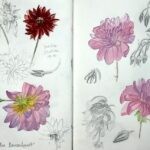
I’ve minimalized my sketching gear to mechanical pencil and watercolor for these studies. Study pages are a way to really observe and draw it from several angles to, well, study it more closely and understand it visually.
I like to reserve one entire spread for these explorations, and have thought about using an even bigger sketchbook – something like A4 might work well. But sketching across the gutter is also fine.
Taking the time for these studies is really fun and rewarding, and it helps to build a kind of visual dexterity: by sketching lots of quick small studies, your observation will improve a lot. Study pages also lead to a very consistent sketchbook design – I often end up liking all of the pages I draw in this way.
You can decide if you’d like to sketch an entire plant (or twig), or a part of it that seems particularly interesting, you can take it apart, magnify certain parts, or show the habitat around it. I sometimes add notes and color swatches to those botanical sketches that can help me identify unknown plants.
On this single page I tried out different techniques for these apple blossom twigs: pencil and watercolor, ink and watercolor, and pencil and colored pencil. I’ve recently gotten new inks (will share more soon) and was eager to try them, but somehow I always end up with my mechanical pencil. Something about the quality of the linework that I like more?

I decided to do another page of apple blossoms in pencil and watercolor, this time focusing on how I add in interesting shadow colors. For colored blossoms I like to use a darker version of the same color, for white blossoms you can try everything from pink, purple to blue, even yellowish gray tones. I think I prefer the twig with the blue shadows, it makes everything look very fresh.

I absolutely love irises and I don’t sketch them enough! If I had a garden, I would plant a full iris field and sketch them each day during their bloom. I’m not too fond of the group of blue irises, but I really like how the individual yellow ones turned out, it was really interesting to see how the shapes change from several perspectives.

These are my most recent study pages on flowers and I’m looking forward to do many more in the coming weeks.
Starting next week, I’ll offer another live run-through of my video course Introduction to Botanical Sketching. It’s a great introduction to botanical sketching, both directly from life and from references, and it will show you how you can capture the beauty of wildflowers in your sketchbook in different techniques.
The course will start on June 11 2024, it’s 4 weeks long and will end on July 9. There will be assignments and individual feedback from me, of course the course also available as a self-paced version (on Gumroad and Skillshare).
P.S. If you’ve already signed up for the self-paced version and want to participate in the feedback rounds, that’s totally possible. Just email me and I’ll send you a link that lets you upgrade: mail@juliabausenhardt.com


Hi Julia, it‘s a pleasure to look at all your sketches, they are wonderful! Thanks for sharing them with us. I think I will do some color-experiments for shadows soon :)
Thank you dear Jasmin! :) Enjoy your shadow explorations!
Hi, Julia —
Looking forward to the botanical sketching course. Here is a truly tangential question: I’m a weaver, so I look at textiles all the time. I couldn’t help noticing that the paint rag shown in the course segment on materials uses the color-and-weave technique to produce complex patterns in a basic over-under-over (plainweave) structure. It looks like it might be handwoven. Am I right, or a little nuts (or both!)?
Hi Rebecca, one thing you definitely are is a nerd! Which is a very good thing in my book. :) I will now think differently about choosing my painting rags.
While I don’t know for sure, I remember the shirt that later became this rag was so inexpensive that I highly doubt it was handwoven. I really liked the pattern though! Can this type of pattern be woven with an industrial loom?
Anyway, enjoy the rest of the course!
Yes, this kind of pattern can be woven on any loom. What creates the pattern is repeating patterns of light and dark threads criss-crossing each other. In an online class given by Jane Stafford, I wove a gamp (a weaving word for “sampler”) where there were seven different light/dark patterns in the warp (the vertical threads), for example, repeating light, dark, or light, light, dark, dark, etc. I then wove the same seven patterns horizontally in squares, which produced 49 separate patterns in one square of cloth. Here it is: https://www.instagram.com/p/C718s9cPlZb/?utm_source=ig_web_button_share_sheet&igsh=ZDNlZDc0MzIxNw==
really enjoy your art. very helpful for the beginner sketcher